
ORIMTECH VETERINARY CT
GEDAMIS
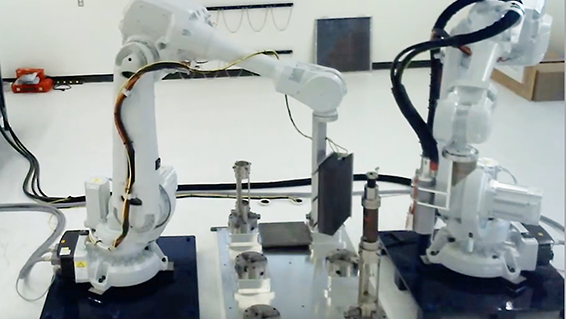
The Orimtech GEDAMIS is a dual-arm robotic multi-modality imaging system engineered for geophysics, petrophysics, and non-destructive testing, built on Orimtech’s ACE/AVRG technology and the proprietary IONA detector. Its defining advantage is the ability to scan samples while they remain an integral part of a larger laboratory assembly, without removal from complex experimental infrastructure. Achieving ±3 Hounsfield unit accuracy even through titanium sample holders and resolving 150-micron details in three-dimensional reconstructions, it delivers a level of quantitative precision that industrial CT and micro-CT alternatives cannot match in true in-situ experimental conditions.
CBCT, NDT & NDE, PETROPHYSICS, IN-SITU SCANNING, ±3 HU ACCURACY, 150 MICRON DETAIL, IONA DETECTOR, DUAL-ARM ROBOTIC
APPLICATION
NDT / NDE
HU ACCURACY
±3 HU
VISIBLE DETAIL
150 micron
DETECTOR
IONA
DESIGN
Dual-Arm Robot
TECHNICAL SPECIFICATIONS
System Specifications
System
System design
Dual-arm robotic CBCT, sample remains integral part of larger assembly
Primary detector
Orimtech IONA proprietary detector
Applications
Geophysics, petrophysics, non-destructive testing, industrial inspection
In-situ capability
Scans samples without removal from complex lab infrastructure
X-Ray technique (example)
140 kVp, 2 mA, 1,060 input views acquired
DICOM / PACS
Full compatibility
Imaging Performance
HU accuracy
±3 Hounsfield units, maintained even under titanium sample holder conditions
Visible detail
150 micron details clearly resolved
Trajectory registration
Orimtech proprietary system trajectory registration for the best possible spatial resolution
Reconstruction engine
AVRG; scatter, beam-hardening, and metal artifact reduction
Image output
Full 3D volumetric CT reconstruction
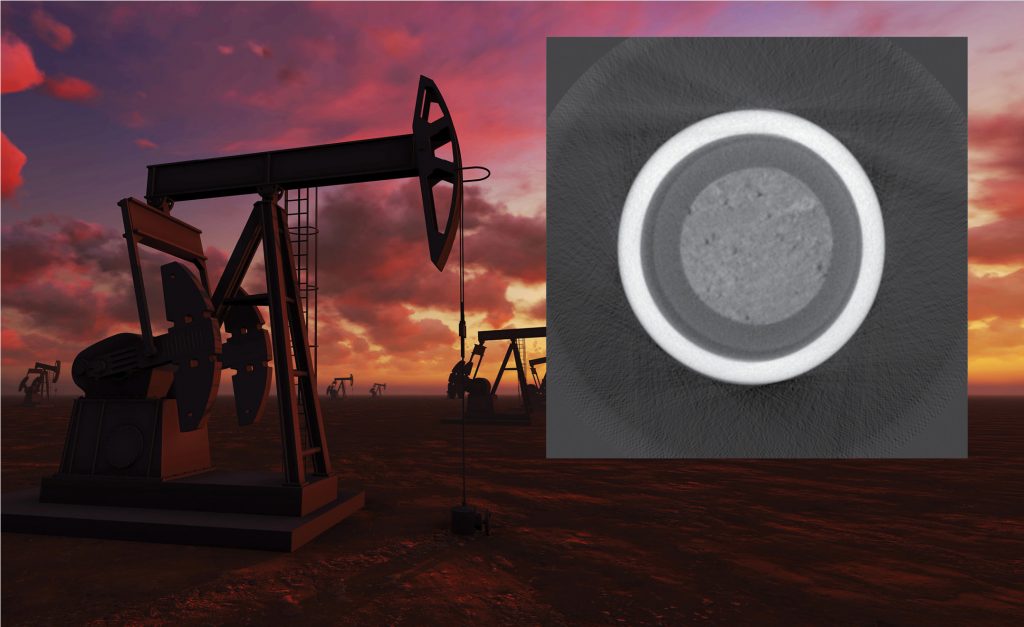
Petrophysics
Primary application
Porous media research; petroleum industry and geophysics
Core sample scanning
Gas and liquid flow characterization through porous media
Sample integrity
No removal from lab infrastructure required, complete in-situ scanning
Data output
Quantitative 3D characterization of porosity, fluid distribution, mineralogy
Sample holder compatibility
Titanium sample holders supported, ±3 HU accuracy maintained
Technology
Detector technology
IONA, Orimtech proprietary high-performance detector
Reconstruction platform
AVRG with scatter correction, beam-hardening correction, MAR
Trajectory flexibility
Circular and non-circular scanning trajectories supported
2D modalities
2D radiography and fluoroscopy acquisition also supported
CLINICAL APPLICATIONS
What this system is built for
The GEDAMIS is built for petroleum industry research laboratories, geophysics institutions, and industrial NDT facilities that require high-accuracy CT imaging of samples that cannot be removed from their experimental environment, delivering quantitative 3D data under true in-situ conditions.
Neurological imaging
Gas and liquid flow characterization through porous reservoir rock is one of the most critical and technically demanding applications in petroleum science, and one that requires CT imaging while the sample remains connected to flow control infrastructure. The GEDAMIS scans core samples in-situ within complex laboratory assemblies, delivering quantitative porosity, permeability, and fluid saturation data without interrupting the experimental setup.
Quantitative CT with ±3 HU accuracy
Orimtech’s proprietary AVRG reconstruction engine and trajectory registration technology maintain ±3 Hounsfield unit accuracy, even under the beam-hardening conditions introduced by titanium pressure vessels and sample holders. This level of quantitative precision enables reliable mineralogy differentiation, fluid phase identification, and material property mapping directly from CT numbers.
Ultra-fine detail NDT & materials inspection
150 micron details are clearly resolved in 3D volumetric reconstructions, making the GEDAMIS applicable to fine-featured industrial inspection beyond petrophysics, including composite material characterization, weld inspection, additive-manufactured component analysis, and fine-structure defect detection in precision industrial parts.
In-situ industrial & research imaging
The dual-arm robotic design moves around the sample rather than requiring the sample to move through a fixed gantry, enabling CT acquisition of objects that are physically integrated into larger test rigs, pressure systems, loading frames, or experimental apparatus. This opens CT imaging to a class of industrial and research applications that conventional fixed-gantry CT systems simply cannot access.